


The Software That Ran the AI Hackathon Was Written the Same Week
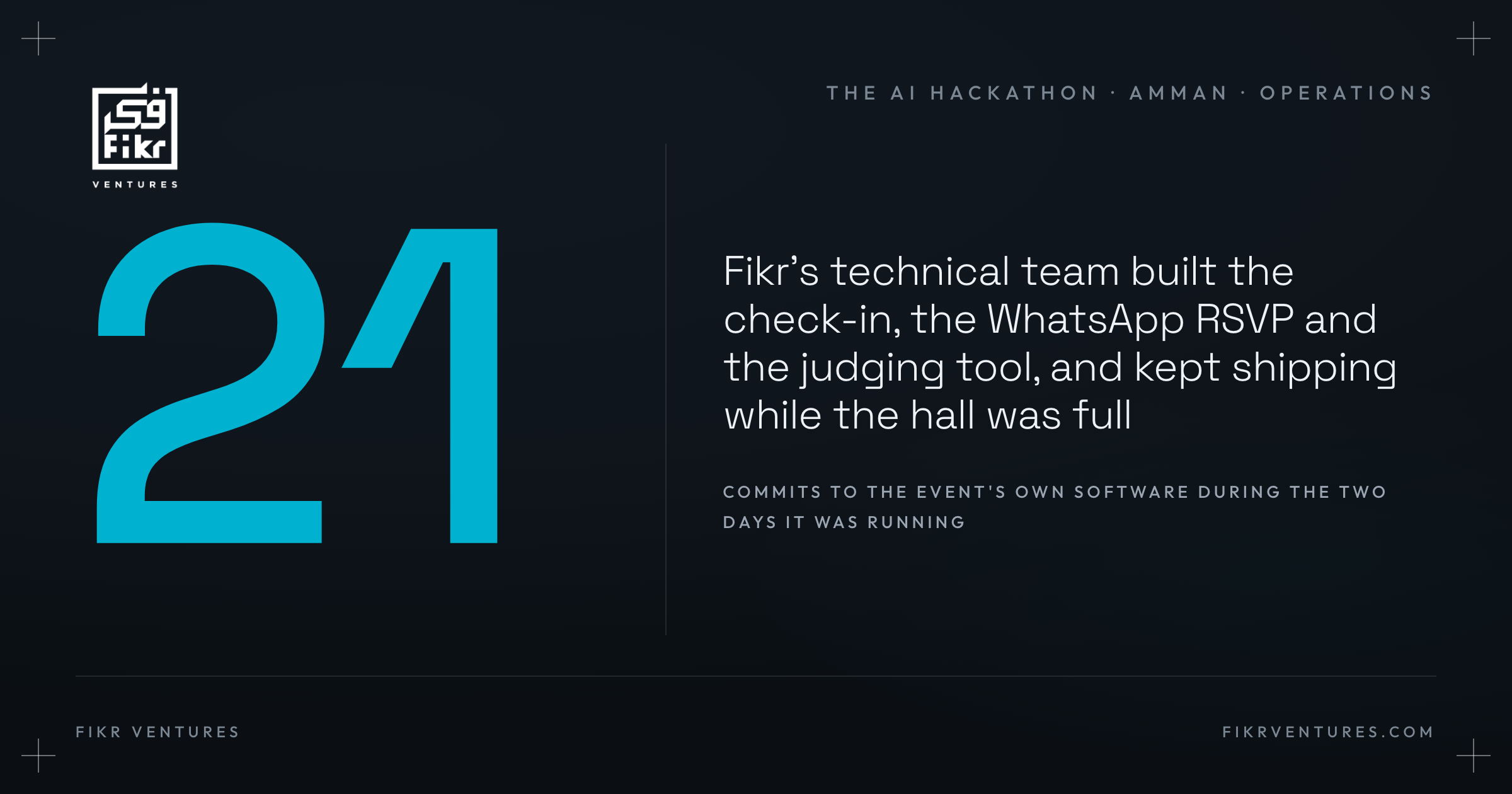
Check-in, QR scanning, the WhatsApp RSVP flow and the Day 2 mentor scoring tool were all built in-house in the days before the event — and 21 commits landed while it was running, the last at 15:50 during the closing show
The AI Hackathon in Amman ran on 10 and 11 October at King Hussein Business Park with 183 builders, more than 50 working prototypes, 10 finalist teams and 4 winners. What is less visible from the floor is that almost every piece of software running the event was written by Fikr Ventures' own technical team in the days before it opened, and kept being written while it ran.
There were three systems. A WhatsApp confirmation and RSVP flow, running on unirsal's number, that invited people, took their replies, held seats and issued day passes. A check-in application with a QR scanner at the door, staff sign-in, a kiosk mode on a door-level code, a live operations dashboard and a team roster. And, on the second morning, a mentor scoring tool that collected nominations from mentor pairs and produced the organiser's live board for picking the final ten.
None of it was bought. The first commit on the WhatsApp flow is dated 4 October at 14:56, six days before doors. The first commit on the check-in application is 6 October at 18:06, four days before. Between them the two repositories hold 103 commits.
The part worth drawing attention to is what happened after the event started.
Twenty-one of those commits were made during the two days the hackathon was running. On the morning of Day 1 at 08:41, a team called Aura formed in the hall and was added to both systems within the same minute. Overnight before doors, the check-in app got its pre-event QA fixes: a scan result that fills the screen in its own colour for ten seconds, a camera that never stops, and a guard against double check-ins. During Day 1 the WhatsApp flow was changed twice — once so a person marked as a late invite could still RSVP after the deadline had passed, and once to accept up to 4,000 characters of free text, because teams had started sending their idea write-ups through it.
Day 2 is the clearest example. The mentor scoring tool did not exist when the day began. Its first commit is 08:57. By 09:46 mentor pairs had three-digit codes and the organiser had a live scores page; by 09:50 the code entry was rate-limited per IP; by 10:27 the flow had been reworked so a pair scores every team first and ranks afterwards. At 12:55 it was changed to accept three-digit team numbers, because team 100 had been added that morning. At 15:14 a crash was fixed that appeared the moment the first nomination came in. At 15:24 and 15:50 the rule itself changed on the organisers' call: a mentor pair could send one to three teams to the final instead of exactly two.
That last commit landed at 15:50, during the closing show.
We are writing this up because it is the part of running an event that nobody sees and because it says something about the team. The tools that organised 183 people, talked to them, let them in, grouped them, scored them and produced the shortlist were built by the same people who organised the hackathon, on the same timescale the participants were working to, and changed in response to what was actually happening in the room.
There is a reason that matters beyond pride in the work. A hackathon asks people to build something real in two days under conditions they did not choose. It is a better event when the organisers are doing the same thing, visibly, at the same time. The rule change at 15:24 took twenty-six minutes to reach the mentors' screens. That is the standard the event was asking of everyone else.
Our thanks to unirsal, whose number and platform carried the WhatsApp side, and whose mark is on every screen of the check-in application.
Related News
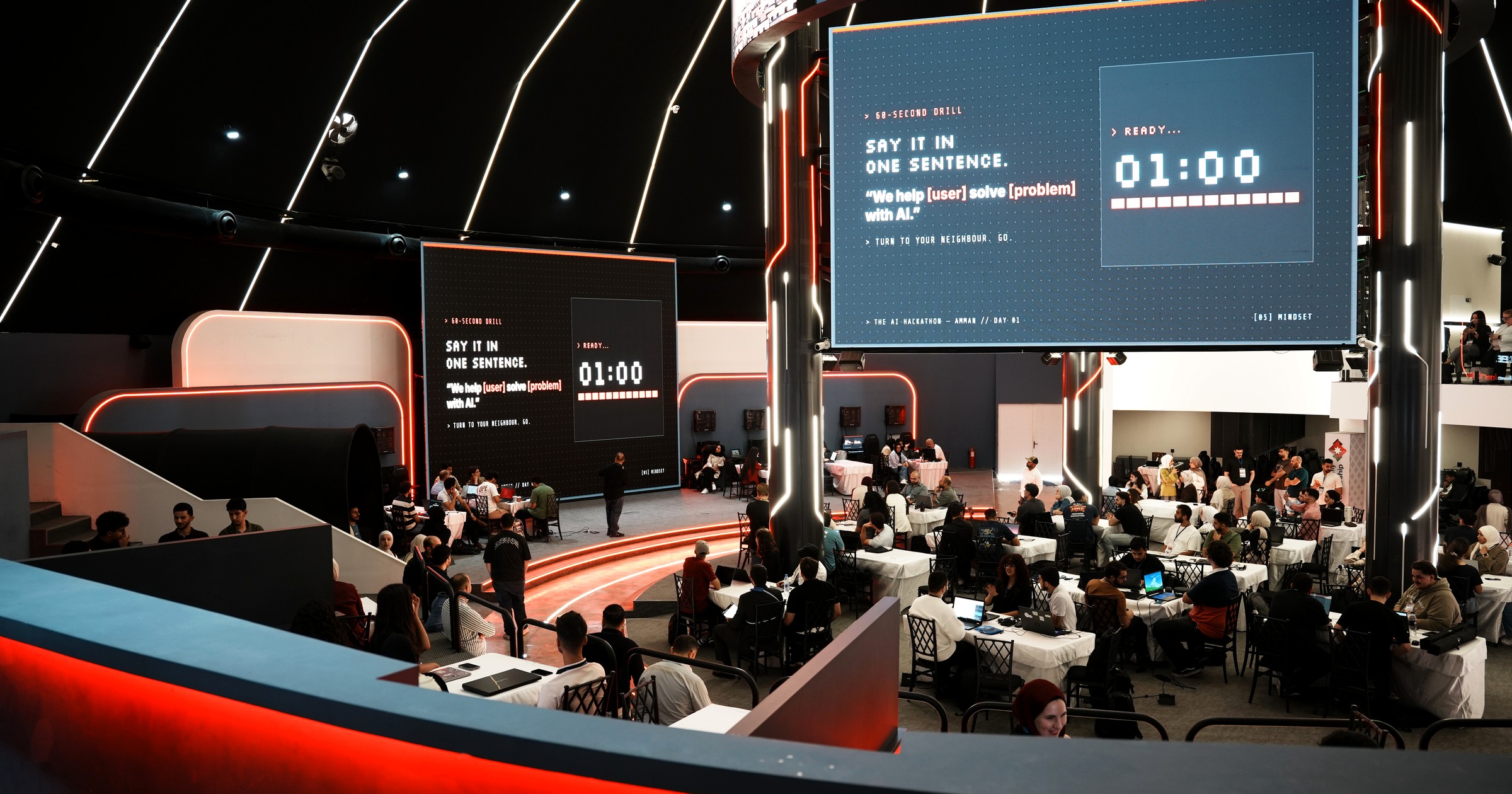
Fikr Ventures and Replit Wrap Up the AI Hackathon in Amman
183 builders, more than 50 working prototypes in two days, and four winning teams — held under the patronage of H.E. Eng. Sami Smeirat, Minister of Digital Economy and Entrepreneurship
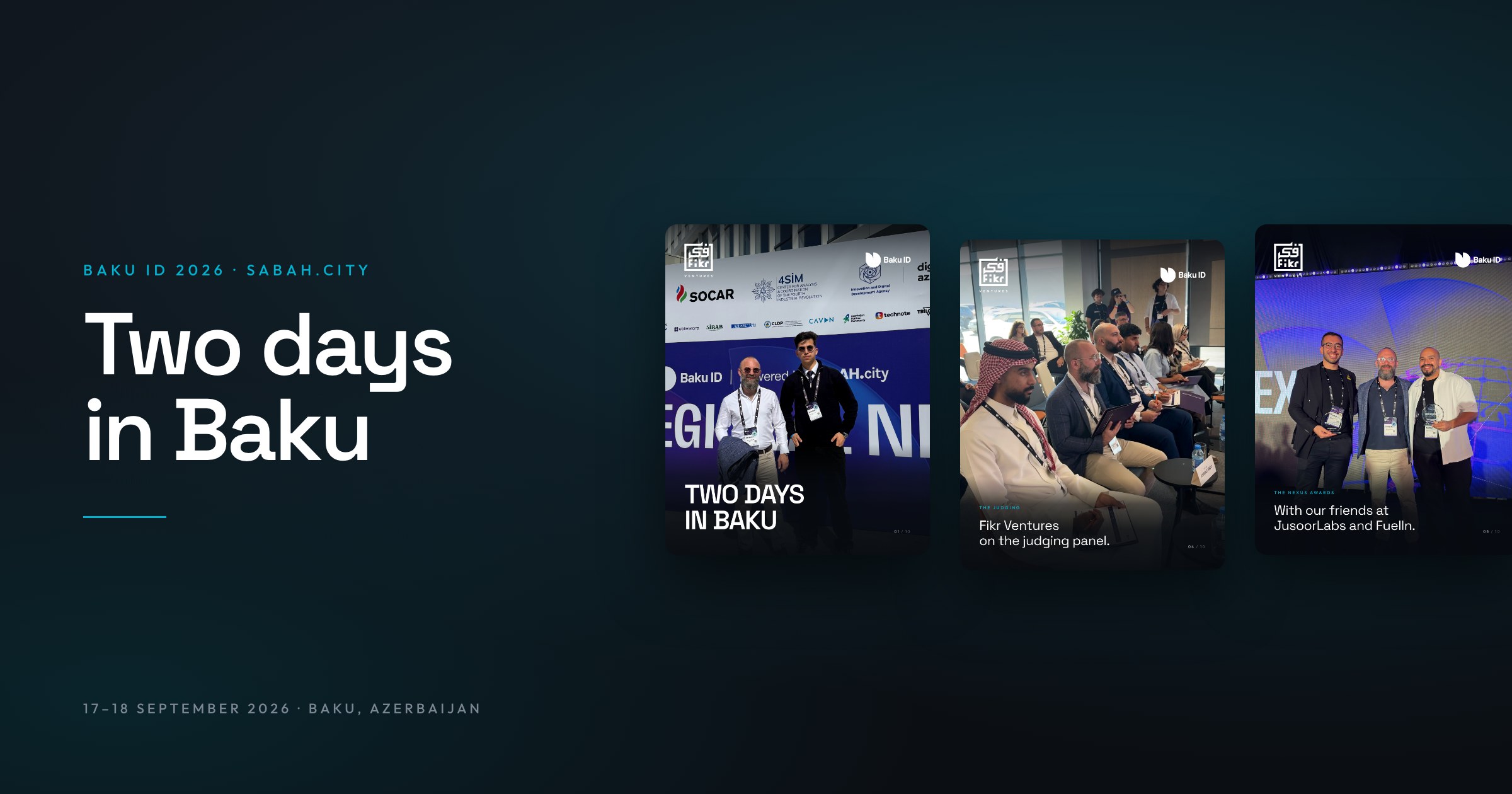
Two Days in Baku
Fikr Ventures spent two days in Azerbaijan for Baku ID 2026 at SABAH.city, sitting on the judging panel for the Nexus Awards and meeting the founders behind the work
Fikr Ventures at Baku ID 2026
Ahmad S Abdo and Abdulhameed Al-Habahbeh are in Baku on 17–18 September for the region’s largest startup festival, held this year at SABAH.city as the innovation district opens