


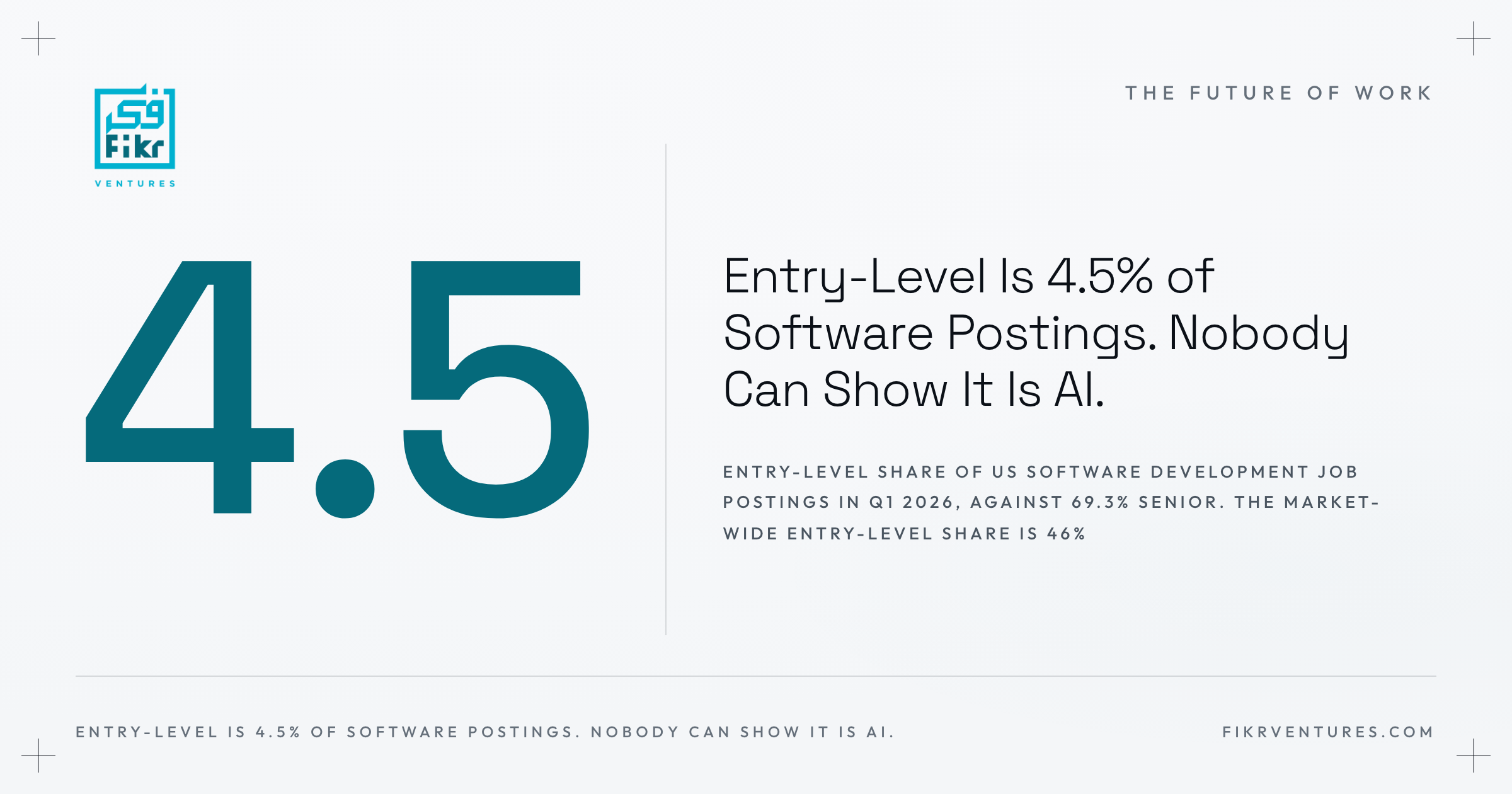
Start with the number that is not in dispute. In the first quarter of 2026, entry-level roles were 4.5% of US software development job postings. Senior roles were 69.3%.
Across the whole US labour market in the same period, entry-level was 46% of postings. Software is not participating in the ordinary shape of a labour market. For anyone running a programme that trains juniors, or funding a company that plans to hire them, that one comparison is the whole problem.
The explanation everyone reaches for is AI. The evidence for that explanation is much weaker than the number itself, and the weakening is being done by the researchers who produced it.
Stanford's 19% comes with the authors' own warning
The most-cited study here found employment of 22-to-25-year-olds in AI-exposed occupations sitting 19% below where it would have been had it tracked less-exposed peers, with no equivalent gap for experienced workers.
The authors describe what they have produced, in their own abstract, as "early, descriptive indicators—canaries in the coal mine—rather than causal estimates."
They then list the concessions themselves. The patterns attenuate when they control for education. Some of the divergence predates generative AI. The effects are stronger in their ADP payroll sample than in national survey benchmarks. And when they hold their specification fixed and rerun it across data vintages, the estimate for the most exposed quintile falls from −10.5 log points at p=0.02 to −5.3 log points at p=0.26 — from significant to not.
There is also a detail in their robustness section that should end a whole genre of commentary. The Current Population Survey, the dataset behind most viral charts about young developers, contains between 23 and 48 young software developers aged 22 to 25 in any given month. Month-to-month swings of 20% or more are routine. Stanford's own authors point this out.
And the paper's first listed finding — the one almost never quoted — is that there is no evidence of widespread, economy-wide job displacement from generative AI.
A study of 243 million hires puts the coefficient at zero
The sharpest challenge comes from Lambert and Schindler, who asked what happens when you stop looking at AI exposure on its own.
Estimated separately, a two-standard-deviation rise in AI exposure and a two-standard-deviation rise in remote-work exposure each predict about the same thing: a fall of roughly 5 percentage points in the junior share of new hires, and about 3 points in the share of job ads asking for limited experience. The two variables move together across occupations, so looking at either alone will find an effect.
Estimated jointly, the remote-work effect holds and "the GenAI coefficient attenuates sharply and is often statistically indistinguishable from zero."
Their proposed mechanism has nothing to do with what a model can write. Remote work suppresses junior hiring by raising the cost of training someone and lowering the return on it. Juniors are expensive to teach when nobody is in the room.
The Stanford team ran Lambert and Schindler's specification on their own ADP data and still found an AI effect. Both teams have replicated, they disagree, and each attributes the difference to the other's dataset. That is an unresolved empirical dispute between two serious groups, which is a different thing from a settled finding.
The source of the viral 65% says the apocalypse did not arrive
SignalFire's 2026 report is where the figure comes from: new-graduate and entry-level hiring at twelve large technology firms down about 65% against 2019, and down about 76% at early-stage startups.
The same report says engineering hiring at those firms is down only 11% versus 2019, that engineers have risen to 55% of all their hiring from 46%, and — in its own words — that "the long-feared 'AI Code Apocalypse' has failed to materialize." Where it does find AI-shaped displacement is in designers, down 48%, and marketers, down 36%.
So the single report behind the "AI is replacing junior engineers" claim reports that firms are hiring proportionally more engineers and fewer designers, and says so explicitly.
Two further qualifications belong with it. SignalFire's 2025 edition put the entry-level decline at "over 50%" rather than 65%, so two different numbers from successive editions of the same report are both in circulation as its finding. And its data comes from public, self-reported LinkedIn profiles, which SignalFire itself flags as possibly inaccurate or incomplete.
The 2025 edition also named a cause, and it was not automation: budget constraints after the end of the low-interest-rate cycle. "AI gets a lot of blame for wiping out junior roles post-2022, but the real story is more nuanced."
What the measurement studies find is close to nothing
Two careful attempts to measure AI's labour effect directly came back with very small numbers.
Humlum and Vestergaard surveyed 25,000 workers across 7,000 Danish workplaces and found no significant effect of AI chatbots on earnings or recorded hours in any of eleven exposed occupations, with confidence intervals tight enough to rule out effects larger than 1%. Average time saved was 2.8%. Those are precise zeros, not a failure to detect.
The Economic Innovation Group tested five different exposure measures from four papers against US employment data and found no detectable effect, observing that unemployment has been rising for young workers and recent graduates "whether they are AI-exposed or not."
EIG also supplies the constraint that should temper every displacement story told at this date: about 9% of US businesses report using AI in producing goods or services, up from 5% eighteen months earlier, reaching around 27% in the information sector. A technology used by one business in eleven is not yet reshaping an economy's hiring.
What we actually think is happening
Three explanations are live, and only one of them is being discussed.
AI capability. Contested, with the two leading teams unable to reconcile their estimates, and the effect vanishing in the dataset with the broadest coverage.
The end of cheap money. Named as the primary driver by SignalFire in 2025, and as a contributing factor by Indeed, which lists Fed rate rises and pandemic hiring normalisation alongside remote work and declines to attribute the shift to AI at all.
Remote work. The only mechanism in this literature that survives joint estimation, with a story that fits what employers actually say: training a junior is a physical, expensive, high-touch activity, and distributed teams stopped paying for it.
For the region we work in, the third is the most useful and the least fatalistic. If entry-level hiring collapsed because models can write the code, nothing a training programme does will help. If it collapsed because firms stopped investing in people they cannot sit next to, that is a problem about apprenticeship and proximity, and it has answers — in-person cohorts, residencies, employer-embedded placements, incubation with a desk attached.
We are not claiming to know which it is. We are pointing out that the version with the weakest evidence is the one being planned around, and that the number nobody disputes — 4.5% against a market-wide 46% — is a fact about hiring practice before it is a fact about machines.